NCC 2025 Condensation Rules: What NSW Builders Need Before May 2027
A wall can pass every inspection and still rot from the inside. NCC 2025 is written to stop that, and NSW builders have until 1 May 2027 to get ready.
Short answer: NSW adopts NCC 2025 on 1 May 2027. NCC 2022 applies until then. The condensation section (Housing Provisions Part 10.8) gets the biggest shake-up for house builders: every climate zone now has a minimum vapour permeance for wall wraps, cooler zones must have a drained and ventilated cavity behind the cladding, and roof ventilation is calculated a new way.
Key takeaways
- ✔ Start date in NSW: 1 May 2027. Jobs approved before then can still use NCC 2022.
- ✔ Climate zones 6, 7 and 8: direct-fix cladding is out. A drained and ventilated cavity is required.
- ✔ Climate zones 4 and 5: no cavity means a Class 4 wrap. With a cavity, Class 3 or 4.
- ✔ Much of Western and South-Western Sydney is zone 6, so this lands on everyday house frames, not just alpine builds.
- ✔ Budget for it now: battens, longer fixings, cavity closers and a better wrap on every external wall.

Why the code cares about a bit of moisture
A family of four puts litres of water vapour into the air every day by cooking, showering and breathing. Modern homes are sealed and insulated far better than they were twenty years ago, so that vapour has fewer ways out. When warm, damp indoor air reaches a cold surface inside the wall, it turns back into water. You get mould on the back of the plasterboard, swollen sheet bracing and damp framing that nobody sees until it smells.
The fix is simple in principle. Let the wall dry to the outside. That takes two things: a wrap that lets vapour through while keeping rain out, and an air gap behind the cladding so the moisture has somewhere to go.
What changes in NCC 2025
1. Wall wraps are rated in every climate zone
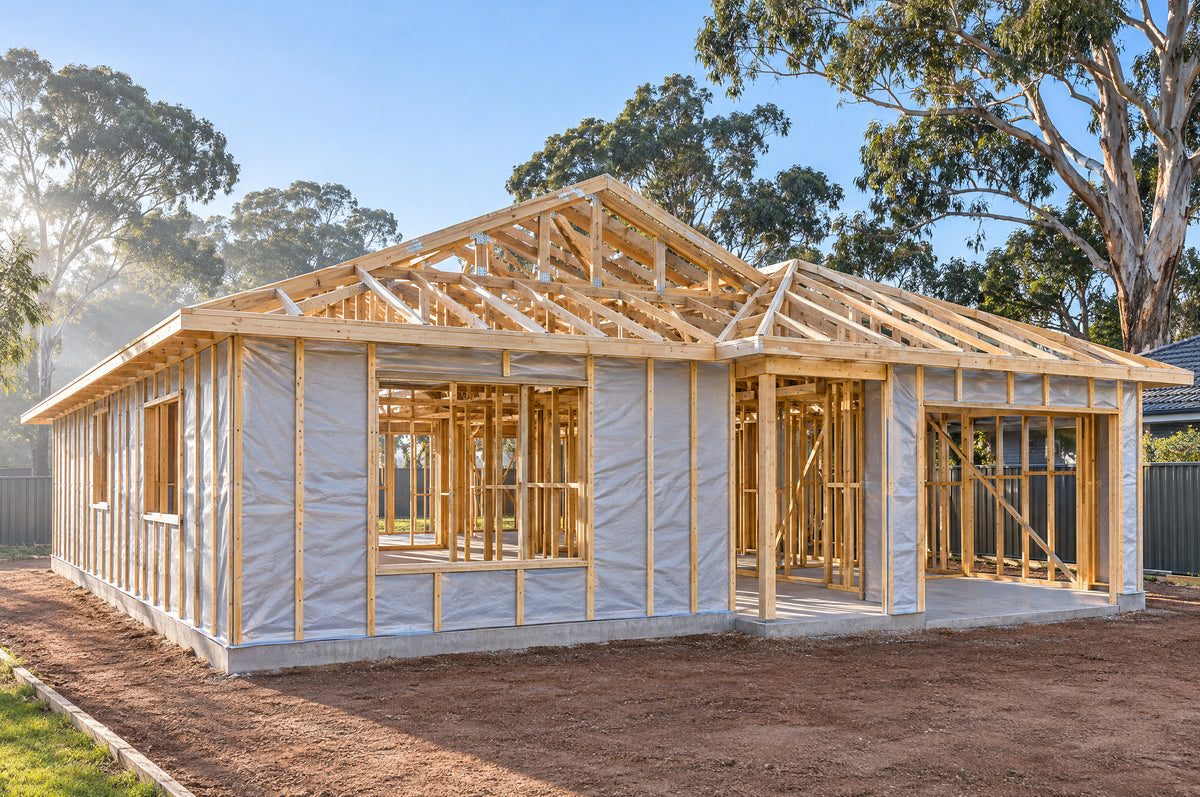
Wraps, sheathing and water barriers on the outside of the insulation are called control layers. Under NCC 2025 each climate zone has a minimum vapour permeance class, tested to AS 4200.1. Class 3 lets through more than 0.143 µg/N.s. Class 4, the most breathable, lets through more than 1.14 µg/N.s.
| Climate zone | Cladding fixed direct (no cavity) | Drained and ventilated cavity |
|---|---|---|
| 1 | Class 2 or 3 | Class 1, 2 or 3 |
| 2 and 3 | Class 3 or 4 | Class 2, 3 or 4 |
| 4 and 5 (coastal and inner Sydney) | Class 4 | Class 3 or 4 |
| 6, 7 and 8 (much of Western Sydney, Blue Mountains) | Not allowed | Cavity required, with a Class 4 wrap |
Summary of HIA's explanatory version of NCC 2025 Table 10.8.1. Always check the table itself and your wall system's documentation.
2. Cooler zones need a cavity behind the cladding
In zones 6, 7 and 8 the cladding can no longer sit hard against the wrap. It has to stand off on battens, with openings top and bottom so water drains and air moves. In practice that means cavity battens, longer nails or screws to reach the frame, a cavity closer or vermin mesh at the base, and flashings set out for the extra wall thickness.
3. Roof ventilation is worked out differently
The method for sizing roof space ventilation has been revised. Small roofs need less than before. If you build in zones 6 to 8, check eave and ridge vent areas with your designer rather than copying the last job.
Which zone is your job in?
Climate zones follow council areas. Coastal and inner Sydney is mapped as zone 5. Much of Western and South-Western Sydney, including the areas we deliver to most, is zone 6. The upper Blue Mountains is zone 7. Check the exact site on the ABCB climate zone map before you price the job, because the wall build-up changes with the zone.
What to order differently
- Wrap: ask for the vapour permeance class in writing. "Breathable" on the roll is not a class.
- Battens: allow treated battens for every external wall in zone 6. H3 treated pine is the usual choice behind cladding.
- Fixings: add the batten thickness to your fixing length.
- Cladding: confirm the manufacturer's cavity fixing details. Our cladding range includes systems designed to go on battens.
- Frames: nothing changes in the framing timber itself, but window reveals and flashings need the extra depth.
Five mistakes we expect to see in 2027
- Pricing a zone 6 house with direct-fix cladding because "that's how we always do it".
- Using foil sarking on walls where a vapour-permeable wrap is required.
- Blocking the cavity at the top with a tight eave lining.
- Forgetting the cavity closer and letting vermin in.
- Ducting the bathroom fan into the roof space and calling it done.
Frequently asked questions
Does my job fall under NCC 2022 or NCC 2025?
It depends on the approval date. In NSW, NCC 2025 becomes mandatory on 1 May 2027. Ask your certifier which version applies to your approval, and get the answer in writing.
Do I need a cavity in zone 5?
Not by default. Without one you need a Class 4 wrap. Many builders will add a cavity anyway because it protects the frame and suits most cladding systems.
Is this only for timber frames?
No. The rules apply to external walls generally. Timber frames benefit most, because a wall that dries out is a wall that lasts.
Will it cost more?
Yes, a little: battens, fixings, closers and labour. It costs far less than opening a mouldy wall in year three.
Need a hand pricing the change?
Send us your plans and we'll quote the frame, battens, wrap and cladding as one order. Request a quote, or open a trade account for trade pricing and 30-day terms. We deliver across Sydney from Ingleburn.
Next in this series: Is your LVL compliant? How to check the stamp before it goes in.
General information as at November 2026, not design advice. Your certifier and designer have the final say on your job.
Sources: HIA, NCC 2025 condensation management changes; HIA, control layers and vapour permeance classes; Master Builders NSW, building regulation update, May 2026; ABCB, condensation mitigation.