Decking in Bushfire Zones: BAL Ratings Explained for Western Sydney
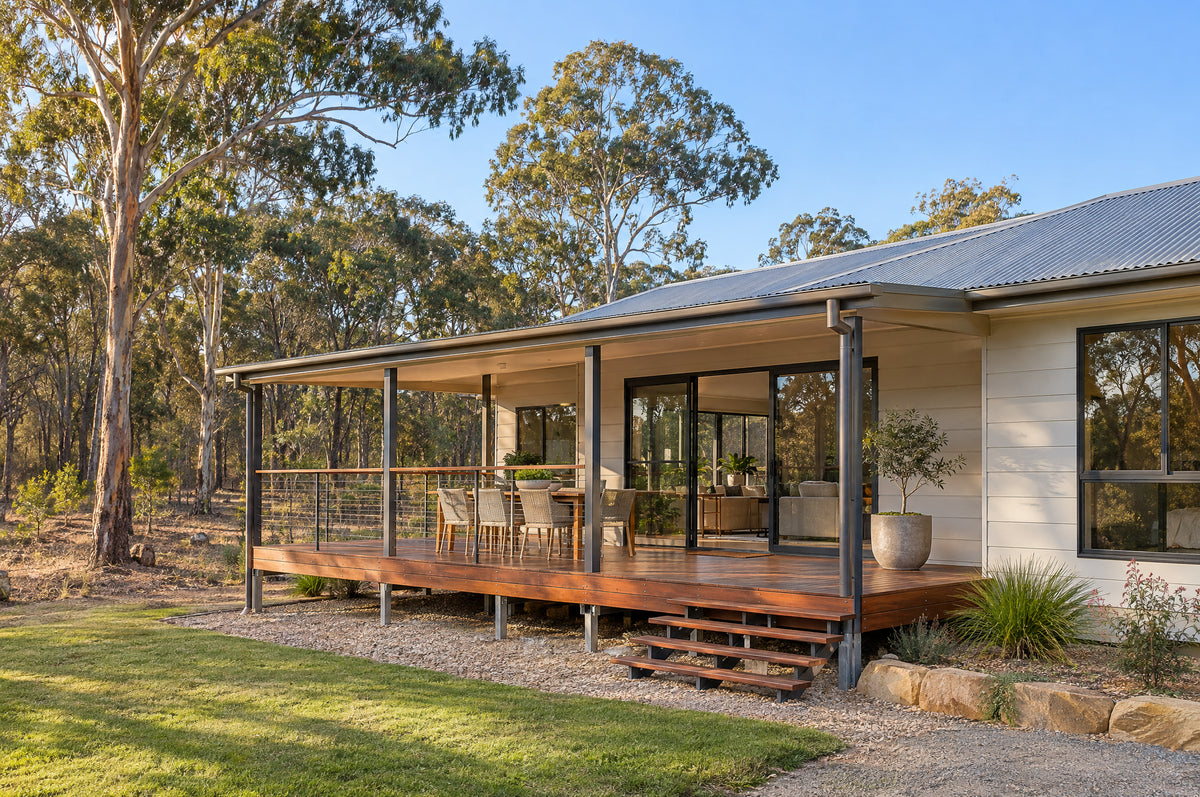
Most houses lost in a bushfire are not reached by the flames. They are lit by embers, and a deck is where embers like to land.
Short answer: if your block is mapped as bush fire prone, it gets a Bushfire Attack Level (BAL). Up to BAL-29 you can still have a timber deck, as long as it is the right timber. At BAL-40 and BAL-FZ, timber boards are generally out and you are into non-combustible or specially tested systems.
Key takeaways
- ✔ There are six levels: BAL-LOW, 12.5, 19, 29, 40 and FZ. The number is the heat the building may face, in kilowatts per square metre.
- ✔ The standard, AS 3959, names seven bushfire-resisting timbers. Merbau is one of them.
- ✔ Standard treated pine is not on that list.
- ✔ A composite board only counts if that exact product has a test report for your BAL.
- ✔ Find out your BAL before you buy anything. It changes the frame as well as the boards.
First, find out if this applies to you
Around Sydney the bush is never far away: the Blue Mountains foothills, the Hawkesbury, Wollondilly, the Georges River corridor, the edges of the national parks. In NSW you can check an address against the bush fire prone land map through the NSW Rural Fire Service website or the NSW Planning Portal.
If the block is mapped, the BAL is worked out from the type of vegetation, how far away it is and the slope under it. A bushfire consultant or your council can assess it, and the result goes on your approval. Do not guess it from the neighbour's.
The six levels, in plain English
| Level | What the house may face | What it means for a deck |
|---|---|---|
| BAL-LOW | Very low risk | No special bushfire requirements. |
| BAL-12.5 | Ember attack | Frame as usual. Boards should be a bushfire-resisting or listed dense timber, or non-combustible, with the tightest rules close to windows and glass doors. |
| BAL-19 | More embers, burning debris, some radiant heat | Much the same as BAL-12.5. |
| BAL-29 | Heavy ember attack and higher radiant heat | Boards must be bushfire-resisting timber or non-combustible. Posts, bearers and joists need to be too, unless the space under the deck is enclosed to the standard. |
| BAL-40 | Very high heat, possible flame contact | Timber decking is generally out. Non-combustible or a system tested for this level. |
| BAL-FZ | Direct flame | Tested systems only, with close involvement from the fire authority. |
A simplified summary of AS 3959:2018 based on industry guides. The standard and your approval conditions are what count.

The seven timbers the standard accepts
AS 3959 lists seven species that are dense enough to be treated as bushfire-resisting without any added treatment:
- Blackbutt
- Merbau (also sold as Kwila)
- Red Ironbark
- River Red Gum
- Silvertop Ash
- Spotted Gum
- Turpentine
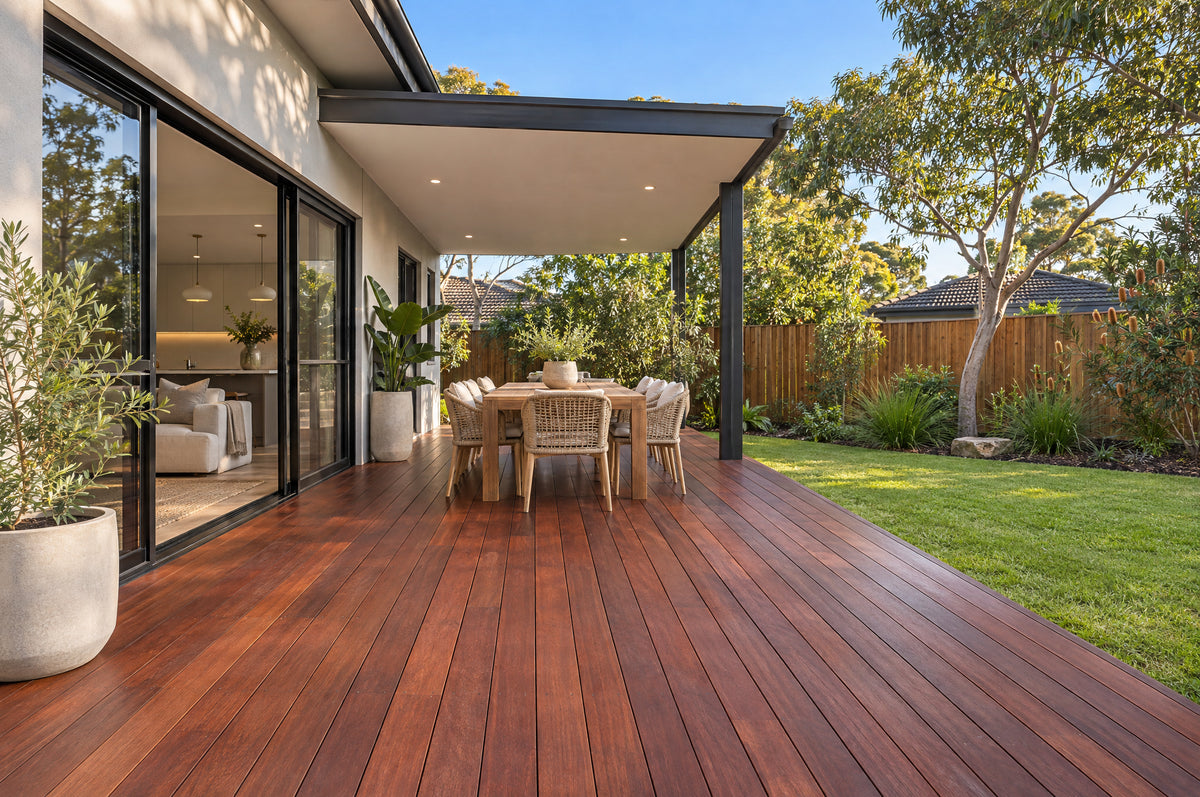
That is why merbau turns up on so many decks along the bushland edge. It is on the list, it is easy to get and it costs less than most Australian hardwoods. We stock 90x19 merbau decking by the lineal metre.
What about composite and treated pine?
Treated pine: the H3 or H4 on the label is about rot and termites. It says nothing about fire. Standard treated pine decking is not a bushfire-resisting timber.
Composite: some composite boards have been tested and are sold as suitable up to BAL-29. Many have not. Ask for the test report for the exact board, including ours, and show it to your certifier before you order. No report, no rating.
The frame and the space underneath
Embers collect under decks. At the higher levels the standard gives you two paths: build the supports and framing from bushfire-resisting or non-combustible material, or enclose the subfloor so embers cannot get in. Steel posts and bearers are a common answer. Whatever your level, these cost almost nothing and help a lot:
- Keep the space under the deck empty. No firewood, no timber offcuts, no gas bottles.
- Use gravel or paving under and around the deck instead of mulch.
- Clear leaves from between the boards and against the house before summer.
- Keep gaps between boards even so debris falls through rather than building up.
Order of operations
- Check whether the land is bush fire prone.
- Get the BAL assessed and written on your approval.
- Choose boards and frame that suit that BAL, with paperwork.
- Give the certifier the species, supplier and any test reports.
- Then order.
Frequently asked questions
Can I build a timber deck at BAL-29?
Yes, with a bushfire-resisting timber such as merbau, blackbutt or spotted gum, and a frame that meets the same level.
Does oiling or painting change the rating?
No. The rating comes from the timber species or the tested system, not from the coating.
Is BAL-12.5 worth worrying about?
Yes. It exists because of ember attack, and embers start most house fires in a bushfire.
My deck is already built. Do I have to replace it?
The standard applies to new work and to alterations that need approval. For an existing deck, the cheap wins are the housekeeping list above.
Building near the bush?
Tell us your BAL and we will quote boards, frame and fixings to suit. Request a quote, or compare costs first in Composite vs merbau vs treated pine decking.
General information as at November 2026. It is not a bushfire assessment. Your BAL certificate, AS 3959 and your certifier decide what you can build.
Sources: WoodSolutions, timber-framed housing in bushfire-prone areas (2025); Standards Australia, AS 3959:2018; ITI Australia, NSW bushfire building guide; Bunnings Trade, checking the BAL rating on your build.